 |
|
Email Newsletter     |
|
|
Recently in Washington Last week the House passed H.R. 5, the Protecting Access to Healthcare (PATH) Act, which provides for needed medical malpractice reform and eliminates the Independent Payment Advisory Board included in President Obama’s health care bill. House Budget Committee Passes 2013 Budget The Budget Resolution must be passed every year by the House and the Senate to set top-level spending limits that Congress then adheres to when crafting its appropriations bills that year. While the House budget sets responsible spending limits and suggests pathways for finding significant savings in mandatory spending programs, the Senate has, for the third year in a row, failed to pass a budget or even offer one. Last Tuesday Senate Budget Committee Chairman Kent Conrad filed to deem automatic spending levels without requiring a vote on them. “I was glad to support this budget proposal and pleased it passed out of the Committee,” said Simpson. “I commend Chairman Ryan for offering this proposal, which, though it is unlikely to receive any counter proposal from Congressional Democrats beyond demagoguery, includes many bold and tough reforms.” The Republican budget offers a real plan to reduce the deficit and cut spending, and puts the country on a fiscally sustainable path. It differs greatly from the budget proposed by President Obama last month. Some of the notable provisions in the Republican budget include:
Simpson has been a strong supporter of deficit reform proposals, like the Simpson-Bowles proposal, that include tax reform, entitlement reform, and significant spending reductions. While the Republican budget is unlikely to receive bipartisan support, it signifies the intention of House Republicans to fix our spending problems and bring the debt back under control. “This budget takes our debt problem seriously, which is, unfortunately, more than we have seen from the White House or the U.S. Senate,” added Simpson. “House Republicans have acted, despite so-called political experts numerous claims that it will hurt us in an election year. We have offered a budget that confronts the problems head on.” The Budget Resolution now moves to the House floor for consideration this week. Simpson Supports Tort Reform and IPAB Repeal Bill “Abuse of existing medical malpractice laws is one of the reasons healthcare in the United States is prohibitively expensive for many individuals,” said Simpson. “Members on both sides of the aisle recognize that medical liability reform would bring down healthcare costs for taxpayers and consumers, as well as improve access to care, and yet Democrats failed to even touch this issue in the partisan Affordable Care Act. I am pleased that H.R. 5 directly addresses the problems in our healthcare system by placing caps on non-economic damages and limiting attorney’s fees. It is estimated to save as much as $120 billion in wasteful spending by reducing unnecessary defensive medicine practices.” In addition to liability reform provisions, H.R. 5 eliminates the IPAB, which was buried in the Affordable Care Act and is made up of a board of unelected bureaucrats tasked with deciding payment rates for Medicare. Included in the ACA is authority for IPAB to operate without public meetings or hearings, consider public input on proposals, or make its deliberations open to the public. “This is a provision of the new healthcare law that I have long been concerned about,” said Simpson. “We all know that without effective reform, Medicare as we know it will not be there for our children and grandchildren. Any changes to Medicare must happen in public, with broad input, and with the best interests of the American people in mind. Unfortunately, the IPAB is authorized to act in the completely opposite manner—with the power to impact America’s Medicare benefits behind closed doors and with little public or congressional oversight.” Congressman Simpson has long been a supporter of meaningful, effective healthcare reform and is a cosponsor of H.R. 5. Simpson Examines NPS Budget Priorities Maintenance backlog and budget priorities: “At the same time, the budget request for federal land acquisition is increased by 4% and the request for LWCF stateside grant funding is increased by 34%. It seems to me that we ought to be addressing long-term maintenance and repair needs, as well as meeting the needs of the visiting public, before making additional land acquisitions that will only add to the historic funding backlog.” Restoration of the National Mall Director Jarvis outlined current restoration efforts, including restoration of the Reflecting Pool near the Lincoln Memorial, implementation of an irrigation system on the Mall’s grass panels, and efforts to mitigate the impact of large events on the Mall. Recently a private donor matched the $7.5 million appropriated in FY12 to address damage to the Washington Monument and its elevator, allowing repairs to move ahead so that the monument can reopen. Aquatic Invasive Species The Park Service hearing was the tenth of 16 budget oversight hearings Simpson has scheduled for the subcommittee this spring. Committee Schedule Tuesday At 10:00 a.m., the House Energy and Water Appropriations Subcommittee is scheduled to hold a hearing on the FY13 budget request for Energy Efficiency and Renewable Energy, Fossil Energy, Electricity Delivery and Energy Reliability at the Department of Energy. Arun Majumdar, Acting Under Secretary for Energy and Assistant Secretary for Energy Efficiency and Renewable Energy; Patricia Hoffman, Assistant Secretary for Electricity Delivery and Energy Reliability; and Charles McConnell, Acting Assistant Secretary for Fossil Energy, are scheduled to testify. At 10:30 a.m., the House Labor, Health and Human Services, and Education Appropriations Subcommittee is scheduled to hold a hearing on the FY13 budget for K-12 education. At 1:00 p.m., Chairman Simpson will hold a House Interior and Environment Appropriations Subcommittee hearing on the FY13 budget request for the National Park Service. Park Service Director Jon Jarvis is scheduled to testify. Wednesday At 10:00 a.m., the House Energy and Water Appropriations Subcommittee is scheduled to hold a hearing on the FY13 budget request for the Bureau of Reclamation. BOR Commissioner Michael Conner is scheduled to testify. At 10:00 a.m., the House Labor, Health and Human Services, and Education Appropriations Subcommittee is scheduled to hold a hearing on the FY13 budget request the Department of Labor. Secretary of Labor Hilda Solis is scheduled to testify. At 2:00 p.m., the House Energy and Water Appropriations Subcommittee is scheduled to hold a hearing on the FY13 budget request for DOE’s Loan Guarantee Program and ARPA-E. ARPA-E Director Arun Majumdar and Loan Guarantee Program Acting Director David Frantz are scheduled to testify. Thursday Floor Schedule MONDAY, MARCH 26TH Legislation Considered Under Suspension of the Rules: TUESDAY, MARCH 27TH Concur in the Senate Amendment to H.R. 3606 - Jumpstart Our Business Startups (JOBS) Act (Suspension, 40 minutes of debate) (Sponsored by Rep. Stephen Fincher / Financial Services Committee) H.R. 3309 - Federal Communications Commission Process Reform Act of 2012 (Subject to a Rule) (Sponsored by Rep. Greg Walden / Energy and Commerce Committee) WEDNESDAY, MARCH 28TH Begin Consideration of H.Con.Res. __ - Establishing the budget for the United States Government for fiscal year 2013 and setting forth appropriate budgetary levels for fiscal years 2014 through 2022 (Subject to a Rule) (Sponsored by Rep. Paul Ryan / Budget Committee) THURSDAY, MARCH 29TH Complete Consideration of H.Con.Res. __ - Establishing the budget for the United States Government for fiscal year 2013 and setting forth appropriate budgetary levels for fiscal years 2014 through 2022 (Subject to a Rule) (Sponsored by Rep. Paul Ryan / Budget Committee) FRIDAY, MARCH 30TH In the News Farm Bureau Report, Voice of Idaho Ag News: Sage Grouse Fire Nikki Watts, the congressman’s spokesperson in Idaho had this to say regarding this issue: "Now more than ever we need to see a return on this investment, not just waste this funding on planning exercises that don't help us reach our goal. Some of the greatest threats to the sage grouse are invasive weeds and wildfire. How will this investment be used to control cheat grass, for example, and prevent fires that destroy sage grouse habitat? Preventing this listing is a top priority for me, and it will require close partnership between federal agencies, states, and local land users. We have to get this one right." Director Abbey noted that the greatest threat to sage grouse is fire and indicated that the bureau is working to prevent and suppress wildfires in core habitat areas. |
MEDIA CENTER
 Simpson Supports Medical Tort Reform 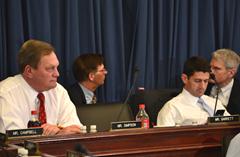 House Budget Passes Committee If you are having trouble reading this message, try viewing the web version |
| BIOGRAPHY | NEWS CENTER | ISSUES | SERVICES FOR YOU | 2ND DISTRICT | CONTACT | |