 |
|
| Email Newsletter | |
|
Recently in Washington Last week the House passed H.R. 2018, the Clean Water Cooperative Federalism Act of 2011, which preserves the authority of each State to make determinations relating to the State’s water quality standards. The House also passed H.R 1309, the Flood Insurance Reform Act of 2011, which reauthorizes the National Flood Insurance Program for five years, reduces rate subsidies, and reforms the program to put it on the path to soundness. Congressman Simpson supported both of these bills. The House also passed H.R. 2354, the Energy and Water Development Appropriations Act of FY2012. This legislation provides the budget for the Department of Energy and the U.S. Army Corps of Engineers, in addition to other agencies, cutting spending by a total of $5.9 billion from the President’s request and bringing the total cost of the bill to below FY2006 levels. H.R. 2354 includes funding for the Idaho National Lab. Congressman Simpson, who is a member of the House Energy and Water Development Appropriations Subcommittee, supported the bill. Simpson’s Interior Appropriations Bill Approved by Committee “This subcommittee has made very difficult choices in preparing this budget proposal, but at the end of the day, what this Committee is attempting to do is all about reducing spending, creating more certainty in the marketplace, and promoting an economic environment conducive to job growth,” Chairman Simpson said during the markup. “If there’s one thing we should have learned from the last Congress, it’s that we can’t spend our way to economic recovery. That didn’t work. All it did was make the hole we’re in much deeper.” The FY12 Interior and Environment Appropriations Act funds agencies under the bill at $27.5 billion, a 12% cut from the President’s budget request and 7% below the FY11 enacted level. To do so, the bill prioritizes funding for agencies’ core missions and programs that have demonstrated value to the taxpayer. For example: “I recognize that the agencies funded under this bill are of keen interest to Idahoans, who live in a state where the federal government owns nearly two-thirds of the land, and I recognize that these cuts will be felt by many, even those who recognize that we need to rein in spending,” said Simpson. “The reality is that getting our economy back on track requires us to make difficult and sometimes unpopular choices. With this bill, we’ve shown that we are willing to do what it takes to make our nation healthy again.” Bill Cuts EPA Budget, Reins in Regulatory Agenda “Earlier this year I said that the scariest agency in the federal government is the EPA,” Chairman Simpson said during the markup. “I still believe that. The EPA’s unrestrained effort to regulate greenhouse gases and the pursuit of an overly aggressive regulatory agenda are signs of an agency that has lost its bearings. Wherever I go, the biggest complaint I hear about the federal government is how the EPA is creating economic uncertainty and killing jobs.” The FY12 Interior and Environment Appropriations Act includes an 18% cut from current levels. Taken together with the $1.6 billion cut included in the FY11 continuing resolution passed in April, Simpson has reduced funding for the EPA by nearly a third during the current calendar year. The bill includes a number of provisions intended to address EPA actions that have created uncertainty in our economy and threaten future economic growth, including: During the Committee markup, additional amendments were adopted that would: “If we really want to do something about the national deficit, we need to get our economy going again. Unfortunately, the EPA is the wet blanket that is preventing small businesses, farmers, and ranchers from investing in their businesses and creating jobs,” said Simpson. “The provisions in this bill are about jobs. They are about creating certainty in the marketplace and assuring businesses that it is safe to start hiring people again without the threat of the EPA—under the guise of protecting the environment—imposing millions of dollars of penalties through regulations that are unreasonable or simply defy common sense.” Bill Provides Agencies with Tools for Responsible Grazing “Today’s grazing practices are vastly different than the ones of the past. The majority of farmers and ranchers recognize that their livelihood depends on a healthy and sustainable environment, and the BLM and Forest Service do a much better job of weeding out the bad players and protecting sensitive areas,” said Simpson. “As a result of this bill, agencies will be able to focus their energies and resources on protecting the most environmentally sensitive areas while carrying out their mission more effectively.” The bill also addresses Equal Access to Justice Act (EAJA) fee payments. “Our ranchers have been under assault by frivolous lawsuits for years, lawsuits that are brought up for no other reason but to obstruct the process in order to control land and water,” said Simpson. “I’m concerned that some groups are basically funding themselves by abusing EAJA, turning suing the government into a cottage industry where taxpayers are the big losers. Our bill shines some light on the EAJA process, requiring detailed reports on the amount of program funds used, the names of the fee recipients, and the hourly rates of attorneys and expert witnesses stated in the applications that was awarded. Until now this information has not seen the light of day, and the public has a right to know how taxpayer dollars are being used.” Highlights: The FY12 Interior and Environment Appropriations Act passed committee and it will be considered on the House floor in the coming weeks. Floor Schedule MONDAY, JULY 18TH H.R. 33- To amend the Securities Act of 1933 to specify when certain securities issued in connection with church plans are treated as exempted securities for purposes of that Act (Suspension, 40 minutes of debate) (Sponsored by Rep. Judy Biggert / Financial Services Committee) TUESDAY, JULY 19TH H.R. 2560 - Cut, Cap, and Balance Act of 2011 (Subject to a Rule) (Sponsored by Rep. Jason Chaffetz / Budget Committee / Rules Committee / Ways and Means Committee) WEDNESDAY, JULY 20TH H.R. 2553- Airport and Airway Extension Act of 2011, Part IV (Subject to a Rule) (Sponsored by Rep. John Mica / Transportation and Infrastructure Committee / Ways and Means Committee) H.J.Res. 66- Approving the renewal of import restrictions contained in the Burmese Freedom and Democracy Act of 2003 (Suspension, 40 minutes of debate) (Sponsored by Rep. Joseph Crowley / Ways and Means Committee) THURSDAY, JULY 21ST, AND FRIDAY, JULY 22ND On Friday, the House will meet at 9:00 a.m. for legislative business. Last votes for the week are expected no later than 3:00 p.m. H.R. 1315 - Consumer Financial Protection Safety and Soundness Improvement Act of 2011, Rules Committee Print (Subject to a Rule) (Sponsored by Rep. Sean Duffy / Financial Services Committee) H.R. 2551 - Legislative Branch Appropriations Act, 2012 (Subject to a Rule) (Sponsored by Rep. Ander Crenshaw / Appropriations Committee) In the News Republicans Working to Put Rewrite of Endangered Species Act on Agenda The Appropriations Committee’s draft fiscal 2012 spending bill includes language that would bar the U.S. Fish and Wildlife Service from using funds to list new species and habitats for protection under the law. Mike Simpson, chairman of the Interior-Environment Appropriations subcommittee, said he included the policy rider to draw attention to the fact that Congress has not reauthorized programs under the law (PL 93-205) since it expired in 1992. “What we’re trying to do is put pressure on all parties that have an interest in this to come to the table and sit down” to work on a reauthorization of the act, the Idaho Republican said during a subcommittee markup of the measure. The full committee is scheduled to mark up the bill Tuesday. Natural Resources Chairman Doc Hastings, R-Wash., whose panel has primary jurisdiction over the law, said he fully supports Simpson’s language. “It needs to be reauthorized, and all parties need to sit down and start talking about that,” he said. “If this leads to that, I am very pleased.” Democrats said that argument does not ring true. “There isn’t an appropriations bill that passes that doesn’t have funding for unauthorized programs in it,” said James P. Moran of Virginia, the top Democrat on Simpson’s panel. “Picking and choosing what you haven’t funded because it wasn’t authorized I think is a little disingenuous.” The gap since the last reauthorization of the law reflects the philosophical divide between the two parties over the Nixon-era statute, which gives the federal government broad powers to protect habitats for threatened species. Republicans, especially from Western states, have long maintained that the law hands environmentalists too much power to challenge energy projects and other activities on public lands. “The fact is we spend far too much money in court instead of recovering species,” Simpson said. Additionally, conservatives complain that the restrictions authorized by the law threaten private property rights. But earlier efforts to overhaul the law have fallen short, even during the presidency of George W. Bush, when Republicans controlled both chambers of Congress for several years. The attempt by House Resources Chairman Richard W. Pombo, R-Calif., to rewrite the law earned him such enmity that environmentalists made his electoral defeat a priority in 2006. His challenger, Democrat Jerry McNerney, received an influx of support from national environmental groups that helped sweep him to victory. Comprehensive reauthorization proposals have not been introduced since. Narrower Bills A House bill (HR 1996) offered by Rep. Cynthia M. Lummis, also a Wyoming Republican, earlier this year aims to curtail plaintiffs attorneys’ fees awarded under federal law, which supporters at the time said was necessary in part to curb rampant litigation brought under the Endangered Species Act and other environmental laws. That effort could receive a boost under report language unveiled Monday for the Interior-Environment spending bill. That language would require the Interior Department, the EPA and the Forest Service to compile for the Appropriations Committee the costs associated with Endangered Species Act litigation. Norm Dicks, a Washington Democrat and the ranking member on the full Appropriations Committee, noted that Simpson’s rider would allow the Interior Department to de-list or downgrade protection of species, but not to add new protections. “It thus creates a one-way ratchet in which wildlife protection can only be weakened,” Dicks said. Bill Snape, senior counsel for the Center for Biological Diversity, said the rider language may in part be in response to an administrative overhaul of the Endangered Species Act that the Interior Department unveiled in May. That plan, he said, takes steps to address longstanding criticism of the law. But Snape said the language in the House spending bill would bar protection for roughly 250 species that federal biologists have identified as needing protection under the law. “The only reason they haven’t been listed is because of a lack of funds,” Snape said. “These are species that are very imperiled and continue to decline, and that’s just a value call about whether you really want to try to protect those species or whether you don’t care, and I assert that the House Republicans by this action are indicating that they don’t care.” |
MEDIA CENTER
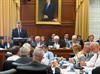 Congressman Simpson chairs the House Appropriations Committee Mark-up.  Congressman Simpson tours St. Luke’s Magic Valley Medical Center If you are having trouble reading this message, try viewing the web version |
| BIOGRAPHY | NEWS CENTER | ISSUES | SERVICES FOR YOU | 2ND DISTRICT | CONTACT | |