 |
|
Email Newsletter     |
|
| Recently in Washington Last week the House of Representatives passed H.R. 1173, the Fiscal Responsibility and Retirement Security Act of 2011, which repeals the CLASS Act, a program included in President Obama’s health care bill that has been determined to be non-implementable. The House also passed two budget reform bills, H.R. 3582, the Pro-Growth Budgeting Act of 2011, and H.R. 3578, the Baseline Reform Act of 2011, as well as legislation to extend the pay limitation for Members of Congress. Sign up for “The I&E Report,” an Interior and Environment Appropriations Update Simpson Questions Bernanke about Debt and Economy “I’ve been a member of this committee with the chairman for eight years now. For eight years we have had economists and other experts tell us we have a structural deficit problem that is unsustainable and we need to do something about it. So far we have failed to heed the warning,” said Simpson during the hearing. He continued, “We are now at a situation where if we don’t heed the warning there is going to be consequences to pay that nobody is willing to accept. We all know that we have to restrain discretionary spending, we all know that we have to get entitlements under control, and we all know that we need a pro-growth tax policy, instead of a 19th century tax code, one that fits the 21st century. We all know that. We might have some differences of exactly how to do some of these things, but well know the problem exists and we all know that we need to come together… if we don’t all these other things we talk about don’t really matter, do they?” Bernanke responded, “Yes, that is correct. It is striking that when the U.S. debt was downgraded by S&P last summer it was more about what they cited as political concerns and the ability of Congress to work together and make progress.” Simpson went on to ask, “Do you believe in the general assumption that $4-6 trillion in savings is the number that will stabilize our deficit and get us headed in the right direction? Could you paint a picture for us of what you think will happen to this economy if we don’t take the steps necessary to stabilize our debt? And what will happen if we put it off another year or another year after that as we have been kicking that can farther down the road forever?” Bernanke replied, “The idea was achieving ($4-6 trillion) would stabilize the debt to GDP ratio and maybe get some progress there, and I was supportive of “going big” so to speak when we were discussing all these issues last summer… The bad case scenario, which ultimately will happen if we don’t change this trajectory, (will be) analogous to what we have seen in some countries in Europe (where) investors will begin to lose confidence that we can manage our long term fiscal situation and we will see sharp movements in interest rates or loss of confidence in U.S. debt. In which case changes would have to made but in a much more chaotic, rapid, and disruptive way, then by doing a long term thoughtful way.” Simpson has been a supporter of efforts to pass sweeping and comprehensive debt reduction legislation that would constrain discretionary spending, reform mandatory programs and fix the tax code. Watch this video to see the entire exchange. House Repeals Flawed Obama Health Care Law Provision The CLASS program, a new entitlement program for long-term care insurance, was instituted as a part of President Obama’s health care bill, but has since been deemed by the Administration to be an unsustainable program which cannot be implemented. “The CLASS program is the kind of law you get when legislation is not properly vetted, but instead is written behind closed doors in an uncontrolled and hectic process,” said Simpson. “However, some continue to support the program despite the Obama Administration’s admittance that it is unworkable and a leading Senate Democrat calling it a ‘Ponzi scheme.’” The numbers behind CLASS’s flaws are stark. Although it was sold as self-sustaining, some analysts estimate that to just break even it would need premiums to be $3,000 dollars per month, or, if it were more reasonably priced, it would need 230 million Americans (more than the entire workforce) to participate. Neither of those scenarios is likely, but they do illustrate how flawed the program is. That said, many fear that the Obama Administration or future administrations could attempt to make the CLASS program mandatory to make it sustainable. Repealing it now would take away that possibility. “The real disappointment with the CLASS program is that those who need care over the long term deserve better. CLASS was never a solution that would work for them. It was filled with budget gimmicks, and it has only distracted from the real problem that still exists today. Long-term care is incredibly expensive, and a gap in the health care system means these folks often end up on Medicaid – further straining its resources.” Simpson added, “I look forward to Congress moving past the failed CLASS program and developing real solutions to these urgent challenges.” The bill moves to the Senate for consideration. Floor Schedule MONDAY, FEBRUARY 6TH Legislation Considered Under Suspension of the Rules: Begin Consideration of H.R. 1734 - Civilian Property Realignment Act (Structured Rule) (Sponsored by Rep. Jeff Denham / Transportation and Infrastructure Committee / Oversight and Government Reform Committee / Rules Committee) The rule provides for one hour of general debate and makes in order the following amendments: TUESDAY, FEBRUARY 7TH, AND THE BALANCE OF THE WEEK On Thursday, the House will meet at 9:00 a.m. for legislative business. Last votes expected no later than 3:00 p.m. On Friday, the House is not in session. Complete Consideration of H.R. 1734 - Civilian Property Realignment Act (Structured Rule) (Sponsored by Rep. Jeff Denham / Transportation and Infrastructure Committee / Oversight and Government Reform Committee / Rules Committee) H.R. 3521 - Expedited Legislative Line-Item Veto and Rescissions Act of 2011 (Subject to a Rule) (Sponsored by Rep. Paul Ryan / Budget Committee / Rules Committee) H.R. 3581 - Budget and Accounting Transparency Act of 2011 (Subject to a Rule) (Sponsored by Rep. Scott Garrett / Budget Committee / Oversight and Government Reform Committee / Ways and Means Committee) Consideration of S. 2038 - STOCK Act (Subject to a Rule) (Sponsored by Sen. Joseph Lieberman / Judiciary Committee / House Administration Committee / Oversight and Government Reform Committee / Financial Services Committee / Agriculture Committee / Rules Committee) Possible Motions to Instruct Conferees on H.R. 3630 - Temporary Payroll Tax Cut Continuation Act of 2011 In the Press Bernanke backs congressional ‘armistice’ call “Although historical experience and economic theory do not indicate the exact threshold at which the perceived risks associated with the U.S. public debt would increase markedly, we can be sure that, without corrective action, our fiscal trajectory will move the nation ever closer to that point,” Bernanke said in testimony to the House Budget Committee. Bernanke also said that Congress should also “take care” not to impede the current economic recovery. He said the two goals were fully compatible. The Fed chairman backed a call from Republican Rep. Mike Simpson of Idaho for an “armistice” between Republicans and Democrats to solve the problem. “I think it is striking that when the U.S. debt was downgraded by S&P last summer ... what they cited was the political concerns about the ability of Congress to work effectively to make progress,” Bernanke said. Bernanke’s discussion of the economy did not vary much from his discussion at last week’s press conference. Bernanke said the economy is gradually recovering but still is vulnerable to shocks. The labor market has shown signs of improvement, he said. “Fortunately, over the past few months, indicators of spending, production, and job market activity have shown some signs of improvement,” Bernanke said. Last week, Fed officials issued new guidance to markets, saying they may hold interest rates close to zero until late 2014 if the economy develops as anticipated. The move surprised markets and showed the central bank is still worried that economic growth is at risk of faltering. The new guidance extends the prior statement that economic conditions were likely to keep rates at the historic low range of 0% to 0.25% until at least mid-2013. The Fed opened a new era of transparency, releasing for the first time the projected path of rates by its 17 members and set a specific inflation goal of 2%. Both Republicans and Democrats expressed unease with the Fed’s inflation goal, which came in a statement on long-run policy. Congress has given the Fed two goals, stable prices and low unemployment. “This appears less to be an inflation targeting statement than an inflation equivocation statement,” said Rep. Paul Ryan of Wisconsin, the chairman of the House Budget Committee. Rep. Lloyd Doggett, a Democrat from Texas, said the Fed should not forget its low employment goal of 5.2 to 6%. At the moment, the unemployment rate is 8.5%. “We’re obviously not satisfied with where we are,” Bernanke said. “I think it is important to emphasize that monetary policy can’t do everything. It is not a panacea,” he said. |
MEDIA CENTER
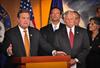 Congressman Simpson speaks at a press conference to introduce a bipartisan letter to the Super Committee 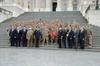 Congressmen Simpson, Labrador and Senator Crapo pictured with the 744 Engineer Company If you are having trouble reading this message, try viewing the web version |
| BIOGRAPHY | NEWS CENTER | ISSUES | SERVICES FOR YOU | 2ND DISTRICT | CONTACT | |