 |
|||
Email Newsletter     |
|||
|
Recently in Washington Last week, the House of Representatives considered and passed two pieces of legislation: H.R. 678, the Bureau of Bureau of Reclamation Small Conduit Hydropower Development and Rural Jobs Act, and H.R. 1120, the Preventing Greater Uncertainty in Labor Management Relations Act. H.R. 678 streamlines environmental regulations to improve hydro power development on existing canals. Congressman Simpson supported the bill, which also passed last Congress in the House. H.R. 1120 requires the National Labor Relations Board to cease all activity requiring a quorum vote until the legal and constitutional uncertainty regarding President Obama’s recess appointments is clarified. Congressman Simpsons supported the bill.Simpson Examines Interior Department Budget Idaho Congressman Mike Simpson Thursday hosted outgoing Secretary of the Interior Ken Salazar at a hearing of the House Interior and Environment Appropriations Subcommittee to discuss budget issues. Simpson, who chairs the subcommittee, oversees the budget for the Department of the Interior. He asked Salazar to discuss what he sees as challenges going forward for the Department, many of which are deepened by sequestration.
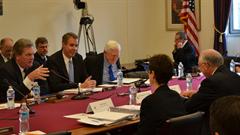
Simpson immediately raised concerns that both the recently-passed Senate continuing resolution and the President’s budget proposal for FY14 fail to adequately address wildfire. The Senate CR struck $97 million for wildfire suppression funding that was included by the House to address widely expected shortfalls in 2013. “One of the surprising things that happened in the CR is that the Senate decided that we don’t need to fund wildfire suppression,” said Simpson. “That decision will likely lead to additional fire borrowing before the end of the fiscal year, robbing operations accounts even further. And now within this budget you’ve also reduced the hazardous fuels account by $87 million, which means that we are also not addressing the long-term costs of fires.” Noting that the 2012 fire season was devastating in Idaho and that the 2013 season is projected to be even worse, Simpson added, “There are very real consequences for failing to provide wildfire funding.” Simpson also talked about the impact sequestration cuts are having on Idaho counties. “Some of the biggest worries I hear from county commissioners in Idaho are about how cuts to PILT [Payment in Lieu of Taxes] and Secure Rural Schools are going to impact their budgets. Most people don’t realize that in some counties, schools would have to shut down if SRS payments went away. These cuts will have very real impacts on Idahoans.” At the end of the hearing, Chairman Simpson commended Secretary Salazar for working to address western issues during his tenure as Secretary of the Interior. Salazar retires at the end of the week, as incoming Secretary Sally Jewell was confirmed by the U.S. Senate last week. Simpson Examines National Park Service Budget Congressman Mike Simpson last week expressed his deep concern over the impacts of cuts to the National Park Service’s operating budget during a budget hearing with the agency. Simpson, who chairs the House Interior and Environment Appropriations Subcommittee, noted that private funding was required for Yellowstone National Park to open on time this spring, and that gateway communities in Idaho are concerned about impacts to their economies.
Simpson blasted the $22 million reduction to the Park Service’s operating accounts—which comes on top of the five percent across-the-board cut under sequestration—included in the Senate continuing resolution. “It’s no secret that sequestration is having a detrimental effect on a number of Park Service functions,” Simpson said. “It’s for this reason that the House actually proposed in its version of the FY13 Continuing Resolution freezing the Park Service operating accounts—in other words, not making additional cuts beyond sequestration. Unfortunately, things didn’t turn out as the House would have liked with regard to your budget.” Simpson asked about the maintenance backlog throughout the Park Service, and the pressure that adding new units may create in a constrained budget environment. He pointed out that he sees no end in sight to the current environment of austere federal budgets, and also questioned how the Park Service is “looking outside the box” in order to create a more stable, long term financial footing for itself. Simpson is a strong advocate for an all-of-the-above approach to our nation’s fiscal challenges. As such, he has supported reducing spending in discretionary accounts to find billions in savings over the past few years. However, discretionary accounts only make up about one-third of federal spending. The other two-thirds comes from mandatory programs like Medicare, Social Security, and Medicaid. Even if Congress completely eliminated discretionary spending, without reforms to mandatory spending, the nation would still have a budget deficit. After the hearing, Simpson said, “Our budget situation requires us to make difficult decisions. It will force us to set careful priorities and do more with the limited resources available. We can either continue trying to offer the same services but be less and less effective at them or we can simply decide not to do certain things any more. I am hopeful that we will not have to completely abandon our national parks, which have rightly been called “America’s best idea,” because we fail to take major steps to reform our entitlement programs.” Simpson: President’s Budget Needs to be More Aggressive Idaho Congressman Mike Simpson responded to the release of the president’s budget for FY 2014. “President Obama’s budget proposal, though it does acknowledge the $16.8 trillion national debt and offers some noteworthy reforms, still falls well short of the kind of long-term serious debt proposal needed to spur growth, restore confidence, and bring common-sense budgeting back to Washington, D.C.,” said Simpson. The President’s budget never comes to balance, and it only offers $1.8 trillion in deficit reduction, less than half of what is needed to stabilize the debt and put it on a downward path relative to the size of the economy. Additionally, it offers up significant tax increases while falling short in reducing spending or reforming mandatory programs like Medicare, Medicaid and Social Security which make up about two-thirds of the budget. “I am encouraged that the President does begin to acknowledge the real drivers of the national debt by finally including some reforms to Medicare and Social Security,” said Simpson. “While it does offer proposals that will trim mandatory spending, it doesn’t go far enough to protect and preserve these programs for the next generation, or reduce their explosive growth.” House Votes to Halt National Labor Relations Board Amid Constitutional Uncertainty Idaho Congressman Simpson supported H.R. 1120, legislation that would prohibit the National Labor Relations Board (NLRB) from taking any actions that would require a panel quorum vote until the constitutional question surrounding the legitimacy of the board members is decided. In January of 2012, President Obama made two recess appointments to the NLRB, but that move was ruled as unconstitutional in a unanimous decision by the D.C. Circuit Court of Appeals because the appointments were not approved by the U.S. Senate as is required, and the Senate was not in recess. The case has been referred to the U.S. Supreme Court. Compounding the problem, the three NLRB board members in question have refused to step off the board, but instead have continued issuing significant decisions despite the questions surrounding their legal authority. Many employers have already begun attempting to block or void rulings of the NLRB and challenge them in court on the basis that they are unconstitutional. If the Supreme Court rules that the President’s appointments were unconstitutional then the hundreds of NLRB decisions since that time would be nullified. “Even labor leaders have admitted that the D.C. Circuit ruling has undermined enforcement of the law,” added Simpson. “It doesn’t make sense to have the NLRB continue issuing major decisions until this question has been answered.” H.R. 1120 would stop the NLRB until either the Supreme Court rules on the constitutionality of the appointments, the Senate confirms the board members constitutionally, or the terms of the board members come to an end at the end of the year. It passed in the house 218-209 and now moves to the Senate for consideration. Committee Schedule Tuesday At 10:00 a.m., the House Labor, Health and Human Services, Education and Related Agencies Subcommittee on Appropriations is scheduled to hold a hearing regarding the President’s FY 2014 Department of Labor budget request. Acting Secretary of Labor Seth Harris will testify. At 1:00 p.m., Chairman Simpson will host a second public witness hearing regarding issues relevant to Interior and Environment Appropriations. Wednesday Thursday MONDAY, APRIL 15TH Legislation Considered Under Suspension of the Rules:
TUESDAY, APRIL 16TH Legislation Considered Under Suspension of the Rules:
WEDNESDAY, APRIL 17TH, AND THURSDAY, APRIL 18TH On Thursday, the House will meet at 9:00 a.m. for legislative business. Last votes expected no later than 3:00 p.m. H.R. 624 - Cyber Intelligence Sharing and Protection Act (Subject to a Rule) (Sponsored by Rep. Mike Rogers (MI) / Permanent Select Intelligence Committee) FRIDAY, APRIL 19TH |
MEDIA CENTER
 House Votes to Halt National Labor Relations Board Amid Constitutional Uncertainty Simpson: President's Budget Needs to be More Aggressive If you are having trouble reading this message, try viewing the web version |
||
| BIOGRAPHY | NEWS CENTER | ISSUES | SERVICES FOR YOU | 2ND DISTRICT | CONTACT | |||