 |
||
Email Newsletter     |
||
|
The United States Needs a Thoughtful Energy Policy By Congressman Mike Simpson
Unfortunately, President Obama’s rhetoric does not match his policies. In the nearly five years that he has been President, his administration has offered more roadblocks than solutions to advancing our country toward energy independence. For example, although our country still heavily relies on imported oil, the Obama administration continues to block permits for increased domestic energy production on our public lands with a myriad of bureaucratic hurdles and red tape. We have the capacity to become energy independent if we can align our policies with safe development of our own resources. According to the U.S. Energy Information Administration, the United States has enough natural gas that is technically recoverable to sustain current consumption levels for over 90 years. In fact, as a result of oil and gas production on non-federal land, during the years of 2011 and 2012, the United States added a total of more than 850,000 barrels per day of oil production. The Congressional Research Service has reported that U.S. oil production has reached levels not seen in more than a decade. On the other hand, between 2007-2012, U.S. oil production fell by almost seven percent on federal lands, where approval from the Obama administration is necessary. Not only does increasing our domestic production of energy enhance our national security by allowing us to rely less on foreign sources of energy, it also creates jobs. The U.S. Energy Information Administration recently released a report that shows a major spike in employment in the oil and gas industry relative to the rest of private sector employment. The report found that from 2007-2012, ‘total U.S. private sector employment increased by more than one million jobs, about one percent. Over the same period, the oil and natural gas industry increased by more than 162,000 jobs, a 40 percent increase.’ One way that President Obama could demonstrate that he truly supports an “all of the above” strategy would be to approve the Keystone XL pipeline. A new study released last week confirmed what the State Department’s initial assessment already found: the Keystone XL pipeline will not impact greenhouse gas emissions. If this project does not move forward, Canadian oil sands will make their way to market through alternative means. That would result in nothing more than a missed opportunity for billions dollars of investment, thousands of jobs created, and an unquestionable boost to the American economy. As a nation, we must continue looking for ways to reduce energy prices and improve our energy independence. I strongly believe that our efforts should be comprehensive in nature and that we should explore every opportunity to develop viable traditional as well as alternative energy sources. I hope that the President can embrace a more realistic approach to our nation’s energy policy by taking steps towards realizing the potential of our own energy abundance. By easing his administration’s burdensome policies, we can decrease unemployment while increasing our national security; two things that should be a priority for all of us.
“I am very concerned about the consequences of engaging U.S. assets in another foreign conflict and believe the White House should consult with Congress before taking any action in Syria,” Simpson said. The letter was sent to the President and reads as follows: Dear Mr. President, We strongly urge you to consult and receive authorization from Congress before ordering the use of U.S. military force in Syria. Your responsibility to do so is prescribed in the Constitution and the War Powers Resolution of 1973. While the Founders wisely gave the Office of the President the authority to act in emergencies, they foresaw the need to ensure public debate – and the active engagement of Congress – prior to committing U.S. military assets. Engaging our military in Syria when no direct threat to the United States exists and without prior congressional authorization would violate the separation of powers that is clearly delineated in the Constitution. Mr. President, in the case of military operations in Libya you stated that authorization from Congress was not required because our military was not engaged in “hostilities.” In addition, an April 1, 2011, memorandum to you from your Office of Legal Counsel concluded: “…President Obama could rely on his constitutional power to safeguard the national interest by directing the anticipated military operations in Libya—which were limited in their nature, scope, and duration—without prior congressional authorization.” We view the precedent this opinion sets, where “national interest” is enough to engage in hostilities without congressional authorization, as unconstitutional. If the use of 221 Tomahawk cruise missiles, 704 Joint Direct Attack Munitions, and 42 Predator Hellfire missiles expended in Libya does not constitute “hostilities,” what does? If you deem that military action in Syria is necessary, Congress can reconvene at your request. We stand ready to come back into session, consider the facts before us, and share the burden of decisions made regarding U.S. involvement in the quickly escalating Syrian conflict.
Congress Must Hold the IRS Accountable By Congressman Mike Simpson They (IRS staff) used names like Tea Party or Patriots and they selected cases simply because the applications had those names in the title. That was wrong, that was absolutely incorrect, insensitive, and inappropriate — that’s not how we go about selecting cases for further review. We don’t select for review because they have a particular name. Since then, some Democrats have tried to divert attention from the issue by claiming the IRS also targeted liberal groups, but an examination of the facts shows that those groups received nothing more than routine scrutiny. Senior IRS officials have placed blame on lower level workers in Cincinnati. The White House has called it a “phony scandal” (while the same day stating “we need to get to the bottom of what happened at the IRS.”) As the scandal continues to generate plenty of noise, one question of mine has still not been answered. How do we prevent this from happening ever again? I hold out little hope that the IRS or the administration will fix the problem independently. After initially claiming they would “hold the responsible parties accountable” a 30-day review by the IRS found “no evidence of intentional wrongdoing.” The House of Representatives is where a real solution to this problem must originate. I have already cosponsored legislation that would help prevent further politically-motivated discrimination by increasing penalties for such behavior. H.R. 1950, the Taxpayer Nondiscrimination and Protection Act would impose a fine of up to $5,000 and/or imprisonment for up to five years. This is a good start. I’ve also cosponsored and voted for H.R. 2009, the Keep the IRS Off Your Health Care Act, which recently passed the House. We learned recently that under Obamacare, the IRS will share personal information, including income and tax filing status, with states and other agencies to confirm whether or not Americans are eligible for tax credits in the new system. The IRS will use tax return data to check that household income matches what applicants declare. There are many people questioning the IRS’s ability to safeguard that information. At this point, the IRS has lost the trust of the American people as a politically unbiased organization, and Obamacare will only allow the IRS to reach further into our lives. Unfortunately, we know that H.R. 2009 stands little chance of passage in the Senate, nor would it be accepted by President Obama. Still, it is important legislation and it sets the bar for future negotiations on IRS policy. But despite these two pieces of legislation, there is more Congress must do in its oversight role. The Oversight Committee and the Ways and Means Committee are engaged in a thorough investigation, and despite the delays and obstruction by the IRS and the administration, Congress must thoroughly examine the facts and scrutinize those who acted improperly and hold them accountable. New policies must be put in place to ensure the IRS will act impartially in the future. This issue is not about scoring political points; it is about restoring American’s trust in their government. This is one step Congress can take to right a wrong and bring transparency and accountability to the IRS. I look forward to these investigations as more information comes to light.
Judges Shouldn’t Manage Federal Lands By Congressman Mike Simpson
Nowhere are these laments more accurate than in the area of federal public land management. Regrettably, extremist organizations and unscrupulous lawyers have been successful over the past few decades in making untrained federal judges, rather than trained federal land managers, the real decision-makers on federal land management actions. Even more regrettably, this transfer of authority from federal agencies to judges has been funded to a large degree by you, the taxpayer, through a broken law known as the Equal Access to Justice Act. The Equal Access to Justice Act, or EAJA, began as a noble effort to provide people harmed by the federal government, but without the means to fight it, an opportunity to recover legal fees if their claims had merit. It was a worthwhile effort based on the concept that everyone should have the opportunity to challenge unjust actions of the federal government. Today, EAJA has an entire industry of litigants built around it – many of whom have made a lucrative career out of second guessing virtually every decision the Forest Service or BLM makes and leaving range and forest lands unhealthy and prone to catastrophic fires. This industry isn’t made up of ma-and-pa storeowners who are barely making ends meet. In reality, EAJA allows any business with a net worth of up to $7 million to participate but has no limits for the many so-called “non-profits” that engage in repeated EAJA abuse. The excesses of EAJA abuse have grown so out-of-control that courts have awarded attorney’s fees as large as $600/hour and, in some cases, these awards go to litigants that haven’t even prevailed in making their case. Worse yet, the federal government seems incapable of keeping track of EAJA payments. The result is that over the past two decades, tens of millions of taxpayer dollars have been awarded to a relatively small number of environmental litigants and that money has been used to file even more lawsuits. To begin a process of reining in these excessive EAJA abuses and limiting the incentives toward public land management through the courts, a number of my Congressional colleagues and I are taking action. As Chairman of the Subcommittee that funds the Forest Service, the Bureau of Land Management, and the EPA, I have authored language requiring these agencies to report to Congress on the yearly costs of litigation, EAJA payments, and any settlements they agree to. And I am cosponsoring legislation that would cap reimbursements at $200 an hour, subject non-profits to the same standard as for-profits, and require that EAJA filers show a direct and personal monetary interest in order to qualify for payments. Through these and other efforts, I am hopeful that we can return EAJA to its noble roots and limit the excessive abuses that have given a good program a bad name. In doing so, we can protect taxpayers from outrageous expenditures, remove the incentives that have led to thousands of needless lawsuits, limit the influence of federal judges in public land management, and restore the appropriate role of trained professionals in the decision-making processes of the Forest Service and BLM.
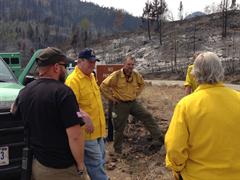
The Importance of Wildfire Funding By Congressman Mike SimpsonIn Idaho, we know the impacts of catastrophic wildfires firsthand. During fire season, many of us are impacted indirectly, and some have felt the heat of the flames as they have fought to protect their homes and livelihoods. As a lifelong Idahoan, I have seen where catastrophic fires have scorched the land so badly that nothing will grow. That’s why, as Chairman of the House Interior and Environment Appropriations Subcommittee, it’s easy for me to understand the value of providing land managers and firefighters with the resources they need to manage and put out fires.
In the FY14 Interior and Environment Appropriations bill, I have ensured that fire suppression is fully funded at the 10-year fire suppression average. Wildfire has a tremendous impact on the budgets of the Forest Service and the BLM—for the Forest Service, wildfire-related costs make up more than half of the agency’s budget. Therefore, in a budget environment where we have had to cut or eliminate “good to do” and even “need to do” priorities in order to address critical human health and public safety priorities, wildfire funding quickly rises to the top of the list. Floor Schedule MONDAY, SEPTEMBER 9TH Legislation Considered Under Suspension of the Rules: 1) H.R. 2052 - Global Investment in American Jobs Act of 2013, as amended (Sponsored by Rep. Lee Terry / Energy and Commerce Committee) TUESDAY, SEPTEMBER 10TH Legislation Considered Under Suspension of the Rules: 1) H.R. 1155 - National Association of Registered Agents and Brokers Reform Act of 2013, as amended (Sponsored by Rep. Randy Neugebauer / Financial Services Committee) WEDNESDAY, SEPTEMBER 11TH, AND THE BALANCE OF THE WEEK On Thursday, the House will meet at 9:00 a.m. for legislative business. Last votes expected no later than 3:00 p.m. On Friday, no votes are expected. H.R. 2775 - To condition the provision of premium and cost-sharing subsidies under the Patient Protection and Affordable Care Act upon a certification that a program to verify household income and other qualifications for such subsidies is operational, and for other purposes (Subject to a Rule) (Sponsored by Rep. Diane Black / Energy & Commerce Committee / Ways & Means Committee) H.J.Res. __ - Continuing Appropriations Resolution, 2014 (Subject to a Rule) (Sponsored by Appropriations Committee) Possible consideration of an authorization for the limited and specific use of military force against the government of Syria to respond to the use of chemical weapons In the News Idaho lawmakers wary of strike against Syria By John Miller, The Associated Press, September 4, 2013
The measure passed 10-7 Wednesday in the Senate Foreign Relations Committee, moving it to the full Senate floor when Congress reconvenes Monday. This week, Risch and Sen. Mike Crapo, along with Reps. Mike Simpson and Raul Labrador, all told The Associated Press they're dubious a strike would really enhance U.S. power abroad, bring a swifter end to Syrian President Bashar Assad's regime or enhance Middle East stability. Obama says Assad's government is responsible for numerous gas attacks, including one Aug. 21 that the U.S. says killed 1,429 people. The Britain-based Syrian Observatory for Human Rights, which collects information from a network of anti-government activists in Syria, says it has been compiling a list of the names of the dead; its toll has reached 502. Before voting against the measure, Risch told Secretary of State John Kerry during a hearing Tuesday that he's worried Assad could emerge a bolder, more-dangerous figure following strikes that aren't aimed at toppling his regime. "If we go in with a limited strike, and the day after, the week after, or the month after, Assad crawls out of his rat hole and says, 'Look, I stood up to the strongest power on the face of this earth - and I won,'" Risch said. The Republican senator said classified intelligence he's seen has convinced him Assad's government is "unquestionably" behind chemical weapons attacks. However, he's doubtful Obama's proposed response — not all-out war, rather surgical strikes aimed at crippling Assad's chemical weapons capacity — and its aftermath have been sufficiently calculated. He added he met months ago with some members of Syria's fragmented opposition, and so far isn't confident a moderate faction would emerge to take the reins, even should Assad be deposed. Risch also said nothing he's heard so far adequately addresses his questions about the reaction of Syrian allies including Russia and the militant group Hezbollah, with its rockets in Lebanon pointed at Tel Aviv, following a U.S. strike. "They are poised, on the northern border of Israel, with a lot of rockets they've brought in. What happens when they get into it with Israel? There's no answer to that," Risch told AP. This week, Russian President Vladimir Putin warned the West against taking one-sided action in Syria but also said Russia "doesn't exclude" supporting a U.N. resolution on punitive military strikes if it's proved Damascus used poison gas on its people. Sen. John McCain, R-Ariz., voted for the resolution, while House Speaker John Boehner of Ohio also backs intervention. Simpson is ordinarily one of Boehner's staunchest allies, but an aide to the eight-term Idaho Republican said the speaker can't count on old allegiances in the Syrian question. "He's strongly leaning against supporting military action," said Nikki Watts, Simpson's spokeswoman in Boise. "However, he's waiting to pass final judgment until he returns to Washington, D.C., next week, where he'll attend intelligence briefings and listen to floor debates." Meanwhile, Labrador has praised Obama's move to allow Congress to weigh in on the matter. Still, the second-term Republican has left little doubt where he stands: So far, Obama and Kerry haven't made the case that key U.S. security interests are at risk. "They weren't really sure what their mission was," Labrador told the AP in an interview Wednesday. "I don't see a clear defined mission. ... We shouldn't be in there just to make a point, just to get a shot across the bow. I don't think that should ever be a reason for us to engage militarily." Crapo acknowledged the deaths of more than 100,000 people during the Syrian civil war and the displacement of 2 million refugees, but said his support for a resolution would be contingent on Obama and Kerry convincing him U.S. involvement would actually protect American's national security interests. "A high bar must be set when considering the engagement of armed forces personnel," the Republican said in a statement. "The president has the responsibility of explaining fully to the American people how intervening in Syria is a part of our strategic interests in the Middle East." |
MEDIA CENTER
 REINS Act Passes House of Representatives If you are having trouble reading this message, try viewing the web version |
|
| BIOGRAPHY | NEWS CENTER | ISSUES | SERVICES FOR YOU | 2ND DISTRICT | CONTACT | ||