 |
||
Email Newsletter     |
||
|
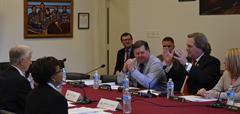
Recently in Washington Simpson: Reducing Fuels Prevents Catastrophic FiresInterior Appropriations Subcommittee Chairman expresses great concern over Forest Service budget proposal Idaho Congressman Mike Simpson blasted a Forest Service budget proposal that cut funding for active forest management in favor of funding the fire budget and new land acquisition. U.S. Forest Service Chief Tom Tidwell testified on the budget in front of the House Interior and Environment Appropriations Subcommittee, which Simpson chairs. The hearing covered a variety of issues, including fire borrowing, Secure Rural Schools, and the states’ role in managing public lands.
Chairman Simpson started the hearing by expressing his concern about the impact that the forest fire budget has on the ability of the Forest Service to manage healthy forests. Because the Forest Service must borrow from other accounts to pay for fire costs when those costs exceed the agency’s budget, the Service’s ability to prevent catastrophic fires in the future could be jeopardized. Simpson noted that today only 30% of the Forest Service’s budget is dedicated to actually managing the national forests, compared to 70% in the mid-1980’s. “Every time I’m in Idaho I hear from Forest Supervisors, District Rangers, and other Forest Service employees that they cannot manage their forests with the shrinking amount of funding they receive,” he said. Simpson noted that the Senate's decision to strip funding intended to reimburse the agency for fire borrowing during the devastating 2012 fire season left the Forest Service with holes to fill in FY14 but expressed concern about the fire budget in the President’s request. “The Senate’s decision not to fund fire in the CR did not do you any favors, but this budget proposal doesn’t seem to help you either,” said Simpson. “Generally, we know that projects reducing the threats of catastrophic fire also create jobs, generate revenue for the Treasury and reduce future fire suppression expenditures. So I am extremely disheartened by the dramatic cuts in hazardous fuels funding. It seems like this budget has enacted fire borrowing before it is needed, stripping funding from other accounts to put it into fire fighting. That concerns me.” “These cuts have real consequences,” he continued, “and they will be felt acutely in communities that depend on public lands for their economic vitality and way of life. In many counties in my district and across the country, public lands make up the vast majority of the land base and are one of the only sources of income for residents. [Yet this] budget proposes to cut recreation, livestock grazing, minerals and energy, and forest products. Essentially, the Administration is cutting the programs that have the most positive impact on the economy.” During the hearing, Simpson also expressed support for extending the Secure Rural Schools program, which provides an alternative source of education funding for counties with a high percentage of national forests or federal land, and encouraged the Forest Service to partner with states to improve forest management. “States have public forests and therefore foresters and public land managers who are already doing some of this work right next to national forests,” said Simpson. “I think there needs to be some way to improve the relationship between the Forest Service and the states so you can partner with state foresters to get some of this work done.” Simpson Praises Passage of Helium Legislation Idaho Congressman Mike Simpson supported H.R. 527, legislation that would address the impending closure of the Federal Helium Reserve later this year by allowing it to continue supplying helium while also reforming our nation’s helium policy. The Federal Helium Reserve was created in 1926 to ensure a steady helium supply for the nation’s defense needs. However, federal demand did not live up to expectations, and by the 1990’s, the Reserve had accrued a $1.3 billion debt. In 1996, Congress passed reforms to require the sale of the Federal Helium Reserve by 2015. The Reserve is expected to pay off the debt earlier than expected, by October 2013, without having sold off all of the helium. As a result, the Reserve, by law, will close and no longer have the authority to sell the remaining 11 billion cubic feet of helium. This will create an immediate worldwide helium shortage and cut the domestic supply in half. “Thousands of high-tech manufacturing jobs in the United States depend on a reliable supply of helium,” Simpson said. “If the Reserve stopped making helium available for sale to private entities, a significant delay might not just slow the production of computer chips, but the computers, life-saving medical devices, and weapons systems that they power.” Micron Technology, based in Boise, is a large semiconductor manufacturer and a global leader in computer memory technology. Micron has been working to develop alternatives to helium, but for some processes, has been unable to find another option. Semiconductor manufacturing is a complex process which can take weeks and use hundreds of processes to make a single chip. It requires sophisticated equipment and techniques developed by the world’s leading scientists and engineers. “The semiconductor industry is not only considered a key American industry, but it is vital to our Idaho economy,” said Simpson. “This industry employs a quarter million people nationwide, and it is one of our largest exports.” H.R. 527 establishes a phased-in process for the sale of helium from the Reserve. Phase 1 will continue Reserve operations as they are under current law for one year to ensure a stable and secure supply of helium in the near term. Phase 2 will establish auctions for helium sales. Revenue from the auctions will go towards operating the Reserve, with any excess directed to the general Treasury; and Phase 3 will reserve the last remaining 3 billion cubic feet of helium for federal national security and scientific needs. H.R. 527 passed in the House 394-1 and now moves to the Senate for consideration. MONDAY, MAY 6TH Legislation Considered Under Suspension of the Rules: 1) H.R. 291 - Black Hills Cemetery Act (Sponsored by Rep. Kristi Noem / Natural Resources Committee) TUESDAY, MAY 7TH, AND THE BALANCE OF THE WEEK On Wednesday, the House will meet at 9:00 a.m. for legislative business and recess immediately. The House will reconvene at approximately 10:30 a.m. for the purpose of receiving, in a joint meeting with the Senate, the Honorable Park Geun-hye, President of the Republic of Korea. On Thursday, the House will meet at 9:00 a.m. for legislative business. Last votes expected no later than 3:00 p.m. On Friday, no votes are expected. H.R. 1406 - Working Families Flexibility Act of 2013 (Subject to a Rule) (Sponsored by Rep. Martha Roby / Education and the Workforce Committee) H.R. 807 - Full Faith and Credit Act (Subject to a Rule) (Sponsored by Rep. Tom McClintock / Ways and Means Committee)
|
MEDIA CENTER
 Simpson Praises Passage of Helium Legislation If you are having trouble reading this message, try viewing the web version |
|
| BIOGRAPHY | NEWS CENTER | ISSUES | SERVICES FOR YOU | 2ND DISTRICT | CONTACT | ||